

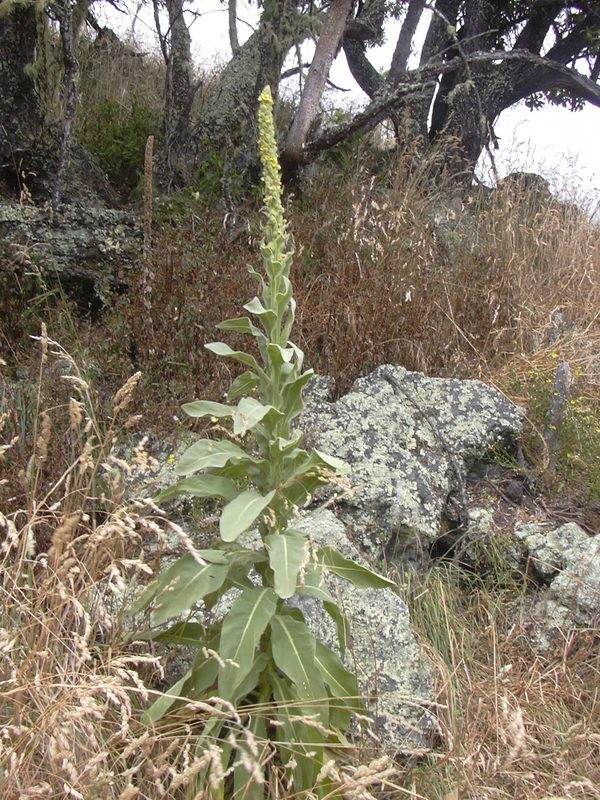
Photo: Forest & Kim Starr · CC BY 3.0 · Source
Mullein
Verbascum thapsus
Family: Scrophulariaceae | Parts Used: Leaf, flower, root
Mullein is a tall, soft-leaved plant with a long track record for respiratory support. Its high mucilage content coats and soothes inflamed mucous membranes, while saponins help loosen and move congestion. Used across Western and Native American herbalism for lung and bronchial congestion, spasmodic coughs, sore throats, earaches, and lymphatic support. Mild-tasting and well-tolerated, it works best when started at the first sign of symptoms.
Traditional Uses
- Lung and bronchial congestion
- Spasmodic coughs
- Sore throat
- Earaches (flower oil)
- Lymphatic congestion support
Key Constituents
Preparations & Dosage
- Infusion: 2-4 tablespoons dried herb (or 4-6 tablespoons fresh) per quart boiling water; drink 2-3 cups daily.
- Mullein flower oil (ear oil): 2-3 drops in the affected ear for earaches.
- Smoking: Roll the dried leaf and smoke for direct respiratory delivery. Used in Native American tradition.
- Topical poultice: Apply as a warm leaf wrap. Wrap in muslin or cheesecloth if skin sensitivity is a concern.
Bonnie's Notes
Mullein tea is effective and mild-tasting. I recommend starting it as soon as symptoms appear rather than waiting. It works best early in a respiratory illness when the mucous membranes are just beginning to get irritated.
Cautions
- May cause contact dermatitis in some individuals.
- Test for allergic reaction or skin sensitivity before topical use. If irritation occurs, wrap the leaf in muslin or cheesecloth as a barrier.
Habitat & Growing Conditions
Native to Europe, North Africa, and Asia. Now widely naturalized across North America, growing in zones 3-9. Thrives in almost any soil type and is a common roadside and disturbed-ground weed. Requires very little care.
Related Articles
Sources & Research
Medicinal Herbs: A Beginner's Guide, Rosemary Gladstar, p171
The Way of Herbs, Michael Tierra, p162
Published Research:
Common mullein (Verbascum thapsus L.): recent advances in research | Phytotherapy Research (2005)
Health-promoting and disease-mitigating potential of Verbascum thapsus L. (common mullein): A review | Phytotherapy Research (2022)
The complete chloroplast genome of Verbascum thapsus L. (Scrophulariaceae) and its phylogenetic affinities | Mitochondrial DNA Part B: Resources (2022)
The Antioxidant, Anticarcinogenic and Antimicrobial Properties of Verbascum thapsus L | Medicinal Chemistry (2020)
These statements have not been evaluated by the Food and Drug Administration. This information is not intended to diagnose, treat, cure, or prevent any disease. If you are under the care of a health care provider or taking prescription medication, check with your provider before using any herbal supplement.