

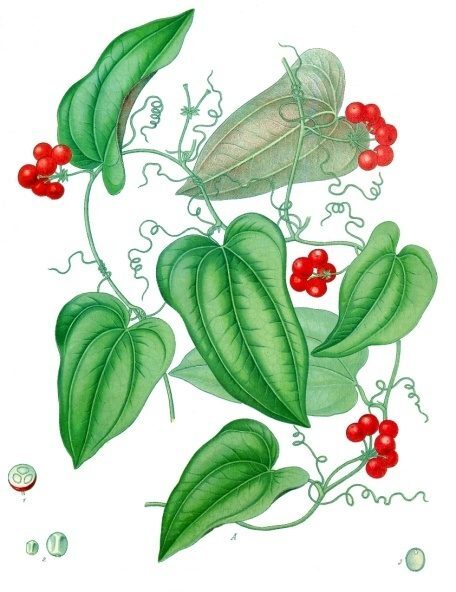
Photo: Franz Eugen Köhler, Köhler's Medizinal-Pflanzen · Public domain · Source
Sarsaparilla
Smilax regelii
Family: Liliaceae | Parts Used: Root
Sarsaparilla is a deeply cleansing root with a sweet, spicy, and mildly cooling nature. Traditionally used in Native American, South American, and Caribbean herbalism for purifying the skin and blood, supporting skin conditions like psoriasis and eczema, and addressing liver disorders. The root's saponins and plant sterols, including parillin and sarsaponin, are responsible for its alterative and anti-inflammatory actions.
Traditional Uses
- Psoriasis, eczema, and skin conditions: traditionally used as a blood purifier and alterative
- Rheumatoid arthritis: anti-inflammatory support
- Venereal diseases: historically used for syphilis and gonorrhea (use alongside, not in place of, modern medical care)
- Liver disorders and function support
- Blood purification
- Anti-inflammatory action for joint and skin conditions
Key Constituents
Preparations & Dosage
Cautions
- May interact with medications metabolized by the liver (CYP450 drugs).
- May increase the absorption of digitalis glycosides and bismuth; use caution alongside heart medications.
- Not recommended during pregnancy.
- Large doses may cause gastrointestinal irritation.
- May have diuretic effects; use with caution alongside diuretic medications.
Habitat & Growing Conditions
Native to Central America and the Caribbean Islands, particularly Jamaica. Prefers hot, humid climates with rich soil.
Related Articles
Sources & Research
The Way of Herbs, Michael Tierra, p189
The New Holistic Herbal, David Hoffmann, p230
Published Research:
The bioactive and traditional potential of Hemidesmus indicus R. Br. (Indian Sarsaparilla) root | Phytotherapy Research (2013)
Indian sarsaparilla, Hemidesmus indicus (L.) R. Br. ex Schult: tissue culture studies | Applied Microbiology and Biotechnology (2020)
Mercury or sarsaparilla: On the pharmacotherapy of venereal diseases by Johannes Franc (1649-1725) and Friedrich Hoffmann | Der Urologe (2021)
Indian Sarsaparilla (Hemidesmus indicus): Recent progress in research on ethnobotany, phytochemistry and pharmacology | Journal of Ethnopharmacology (2020)
These statements have not been evaluated by the Food and Drug Administration. This information is not intended to diagnose, treat, cure, or prevent any disease. If you are under the care of a health care provider or taking prescription medication, check with your provider before using any herbal supplement.