

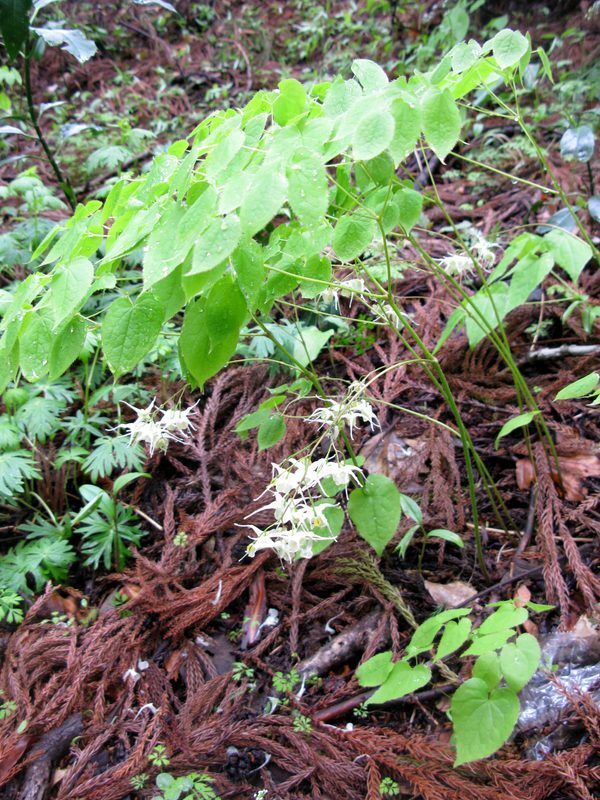
Photo: Qwert1234 · CC BY-SA 3.0 · Source
Horny Goat Weed
Epimedium koreanum
Family: Berberidaceae | Parts Used: Aerial parts
Horny Goat Weed is a Traditional Chinese Medicine herb used primarily for male reproductive support and vitality. Its key constituent, icariin, has been studied for antiplatelet, cardiovascular, and antitussive effects. In TCM, the herb is classed as pungent and warm, used to tonify kidney qi and support respiratory function. It has also been researched for antirheumatic properties and its influence on cardiovascular health.
Traditional Uses
- Male reproductive support and vitality tonification
- Antitussive and expectorant for respiratory congestion
- Kidney support, traditionally used to tonify kidney yang in TCM
- Antirheumatic use for joint discomfort
- Aphrodisiac tonic in classical Chinese medicine formulas
Properties
Key Constituents
Preparations & Dosage
- Decoction: 1-2 tsp dried herb simmered in 1 cup boiling water; or 1 oz dried herb per 1 pint of water. Take 1 cup once or twice daily.
TCM Profile: Pungent, warm.
Cautions
- May interact with blood thinners and blood pressure medications.
- May lower blood pressure; use with caution if you have hypotension.
- Not recommended during pregnancy or breastfeeding.
- High doses or prolonged use may cause dizziness, dry mouth, nosebleeds, or irregular heartbeat.
- May have estrogenic effects; avoid in hormone-sensitive conditions.
Habitat & Growing Conditions
Native to mountainous regions of China, the Himalayas, and Japan. Prefers moist soil in full to partial shade. Typically found at elevation in forested understory zones.
Related Articles
Sources & Research
The Way of Herbs, Michael Tierra, p135
Encyclopedia of Herbs, Deni Bown, p202
Published Research:
A systematic review of traditional uses, phytochemistry, pharmacology and toxicity of Epimedium koreanum Nakai | Journal of Ethnopharmacology (2024)
Antiplatelet and Antithrombotic Effects of Epimedium koreanum Nakai | Evidence-Based Complementary and Alternative Medicine (2021)
Epimedium koreanum Nakai-Induced Liver Injury: A Mechanistic Study Using Untargeted Metabolomics | Frontiers in Pharmacology (2022)
Epimedium koreanum Extract and Its Flavonoids Reduced Atherosclerotic Risk via Suppressing Modification of Human HDL | Nutrients (2019)
These statements have not been evaluated by the Food and Drug Administration. This information is not intended to diagnose, treat, cure, or prevent any disease. If you are under the care of a health care provider or taking prescription medication, check with your provider before using any herbal supplement.