

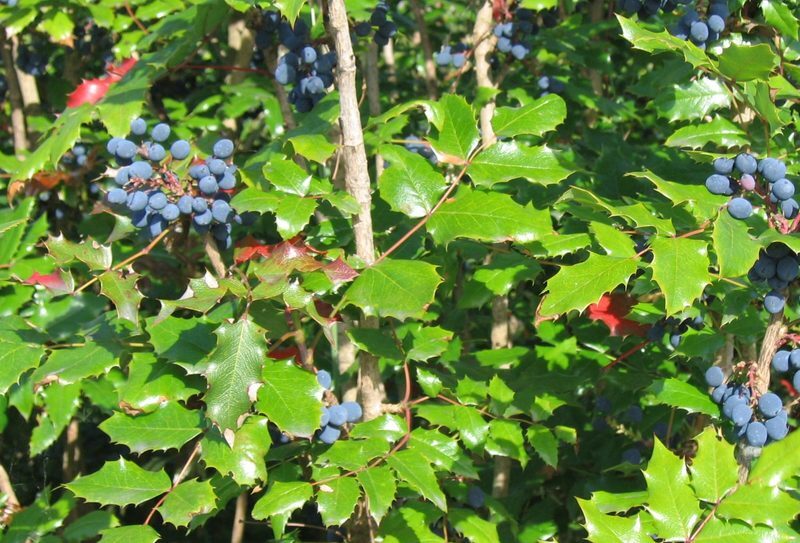
Photo: The original uploader was Meggar at English Wikipedia. · CC BY-SA 3.0 · Source
Oregon Grape
Mahonia aquifolium
Family: Berberidaceae | Parts Used: Root
Oregon Grape root has been traditionally used by Native American peoples of the Pacific Northwest for liver support, skin conditions, bronchial congestion, and blood purification. Its primary active compound, berberine alkaloid, is one of the most studied plant alkaloids in herbal medicine, with well-documented antimicrobial and anti-inflammatory properties. I regularly use this in respiratory blends and as a liver and bile-supporting herb.
Traditional Uses
- Liver disease and hepatic function support
- Skin conditions including eczema and psoriasis
- Bronchial congestion
- Blood purification and circulatory health
- Promotes bile flow (cholagogue)
- Blood cleanser (alterative)
Properties
Key Constituents
Preparations & Dosage
- Decoction: 1-2 teaspoons dried root simmered in 1 cup boiling water, or 1 oz dried root decocted in 1 pint water. Drink 1-3 cups daily.
- Tincture: 15-30 drops taken 1-3 times daily.
TCM Profile: Bitter, cool.
Bonnie's Notes
I regularly use Oregon Grape in respiratory blends. It pairs well with other respiratory herbs and adds bitter, bile-stimulating action that supports thorough elimination.
Cautions
- Avoid during pregnancy and lactation.
- Contains berberine, which may interact with diabetes medications, blood thinners, and drugs metabolized by CYP450 enzymes.
- Not recommended for long-term use.
- May cause gastrointestinal upset.
- Should not be used by individuals with liver disease without medical supervision, despite its traditional use as a liver herb.
Habitat & Growing Conditions
Native to the Pacific Northwest of North America. Hardy to USDA zones 5-9. Prefers well-draining, moist, slightly acidic soils. Grows as an evergreen shrub in forest understories and is widely cultivated as an ornamental plant.
Related Articles
Sources & Research
The Way of Herbs, Michael Tierra, p. 173
Today's Herbal Health, Louise Tenney, p. 94
Published Research:
Review of the Efficacy and Safety of Topical Mahonia aquifolium for the Treatment of Psoriasis and Atopic Dermatitis | The Journal of Clinical and Aesthetic Dermatology (2018)
A report on three recent clinical trials using Mahonia aquifolium 10% topical cream and a review of the worldwide clinical experience | American Journal of Therapeutics (2005)
Antitumoral and Immunomodulatory Effect of Mahonia aquifolium Extracts | Oxidative Medicine and Cellular Longevity (2019)
Effects of Mahonia aquifolium ointment on the expression of adhesion, proliferation, and activation markers in the skin of patients with psoriasis vulgaris | Forschende Komplementarmedizin (1999)
These statements have not been evaluated by the Food and Drug Administration. This information is not intended to diagnose, treat, cure, or prevent any disease. If you are under the care of a health care provider or taking prescription medication, check with your provider before using any herbal supplement.