

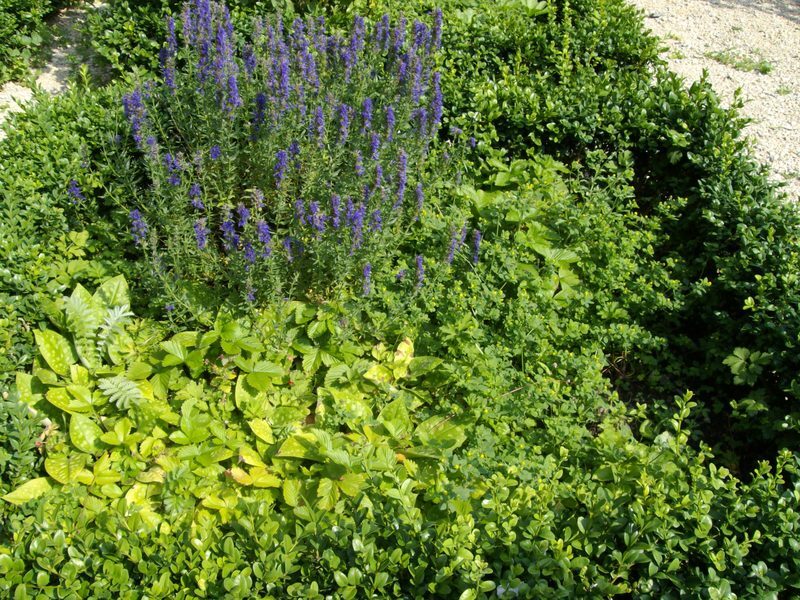
Photo: Harmonia Amanda · CC BY-SA 3.0 · Source
Hyssop
Hyssopus officinalis
Family: Labiatae | Parts Used: Aerial parts, dried
Hyssop is a fragrant, warming herb with a long history in Western and Middle Eastern herbalism. It is best known for respiratory support, specifically for relieving coughs and bronchitis through its expectorant and antispasmodic action. Its calming nervine properties are traditionally used for mild anxiety. Hyssop is also one of the herbs I use most often for spiritual cleansing in baths and floor washes.
Traditional Uses
- Coughs and bronchitis, particularly with thick or sticky mucus
- Gentle expectorant to loosen and move congestion
- Mild anxiety and nervous tension support via calming nervine action
- Digestive carminative for gas and cramping
- Spiritual cleansing: traditionally used in baths and floor washes to remove negativity
Properties
Key Constituents
Preparations & Dosage
Spiritual & Folk Uses
Hyssop is traditionally used in spiritual baths and floor washes across Western folk traditions and Afro-Caribbean practices to clear away negativity and create a sense of renewal. It appears in the Hebrew Bible as a purification herb, used in ritual cleansing ceremonies. I primarily use hyssop for this purpose in my own practice.
Bonnie's Notes
I reach for hyssop primarily for spiritual work rather than medicinal use. It's a staple in my spiritual baths, and I find it pairs well with other cleansing herbs like rue and basil in a floor wash.
Cautions
- Avoid during pregnancy.
- Use only in small doses; avoid large amounts.
- Not recommended for people with high blood pressure or epilepsy.
- Avoid long-term continuous use.
Habitat & Growing Conditions
Native to the Eastern Mediterranean region. Cultivated widely in US zones 4-8 and parts of Canada. Prefers well-drained soil in full to partial sun. A woody perennial shrub that attracts bees and butterflies.
Related Articles
Sources & Research
The New Holistic Herbal, David Hoffmann, p207
Herbs: An Illustrated Encyclopedia, Kathi Keville, p107
Published Research:
Ontogenetic and Environmental Variability of Hyssop (Hyssopus officinalis L.) Essential Oil Composition and Activity | Plants (Basel, Switzerland) (2026)
Chemical and Biological Properties of Different Romanian Populations of Hyssopus officinalis Correlated via Molecular Analysis | Plants (Basel, Switzerland) (2024)
Phytochemical Profile and Antioxidant and Protective Activities of Various Types of Extracts from Hyssopus officinalis | Current Topics in Medicinal Chemistry (2024)
Sustainable-Green Synthesis of Silver Nanoparticles Using Aqueous Hyssopus officinalis and Calendula officinalis Extracts | Molecules (Basel, Switzerland) (2022)
These statements have not been evaluated by the Food and Drug Administration. This information is not intended to diagnose, treat, cure, or prevent any disease. If you are under the care of a health care provider or taking prescription medication, check with your provider before using any herbal supplement.