

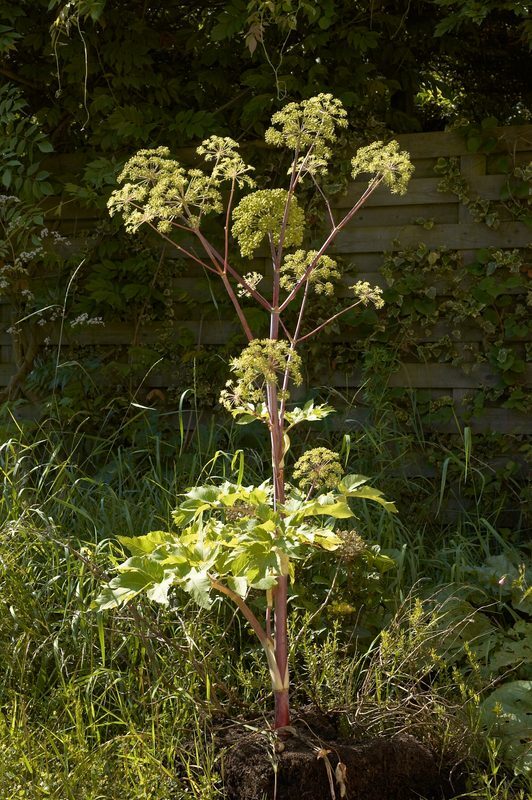
Photo: Wouter Hagens · CC BY-SA 3.0 · Source
Angelica
Angelica archangelica
Family: Umbellifereae | Parts Used: Roots, leaves
Angelica is a biennial herb native to Northern Europe and Iceland, valued historically for its aromatic and medicinal qualities. Medieval monks utilized it medicinally, and folklore attributes its name to a vision where Archangel Raphael identified it as a plague traditional use. It belongs to the Umbelliferae family and contains essential oils, angelica acid, coumarin compounds, bitter principle, and tannin.
Traditional Uses
- Supports relief from coughs, bronchitis, and pleurisy
- Acts as an appetite stimulant
- Helps regulate women's menstrual cycles
- Antispasmodic properties
- Carminative properties
- Diuretic properties
- Diaphoretic properties
- Expectorant properties
- Anti-anxiety and cognition-enhancing properties
Properties
Key Constituents
Preparations & Dosage
- Decoction: 1-2 teaspoons root in 1 cup boiling water, or 1 ounce dried root per pint of water; boil 2 minutes, steep covered 15 minutes; take 1 cup three times daily
- Tincture: 15-30 drops three times daily
- Compress: Made with leaves, applied to chest
Spiritual & Folk Uses
Protection, uncrossing in folk practices. Use in a mojo bag or burn in an incense blend.
Fun Fact
Medieval monks made medicines from Angelica to help treat the plague; it has been said that its name was given by a monk when Archangel Raphael descended and said it was a treatment for the plague.
Cautions
- Avoid taking very large amounts.
- Contains furanocoumarins which may cause photosensitivity; avoid excessive sun exposure during use.
- Repeatedly touching leaves may cause dermatitis.
- Not evaluated by FDA.
- Consult healthcare provider before use if pregnant, nursing, on medications, or with existing health conditions.
- Contraindications: allergy-apiaceae, blood-thinners, breastfeeding, photosensitivity, pregnancy
Habitat & Growing Conditions
Likes moist soil in full to partial shade. Grown in USDA zones 4-9.
Sources & Research
The New Holistic Herbal, David Hoffmann p175
Herbs An Illustrated Encyclopedia, Kathi Keville p38
Published Research:
Understanding the phytochemistry and molecular insights to the pharmacology of Angelica archangelica L. (garden angel... | Phytotherapy research : PTR (2021)
Medicinal properties of Angelica archangelica root extract: Cytotoxicity in breast cancer cells and its protective ef... | Journal of integrative medicine (2019)
Comprehensive identification of terpene synthase genes and organ-dependent accumulation of terpenoid volatiles in a t... | Plant biotechnology (Tokyo, Japan) (2022)
Angelica archangelica and Ginkgo biloba Extracts Recover Functional Blood Hemoglobin Derivatives in Rabbits Exposed t... | Current pharmaceutical biotechnology (2022)
These statements have not been evaluated by the Food and Drug Administration. This information is not intended to diagnose, treat, cure, or prevent any disease. If you are under the care of a health care provider or taking prescription medication, check with your provider before using any herbal supplement.