

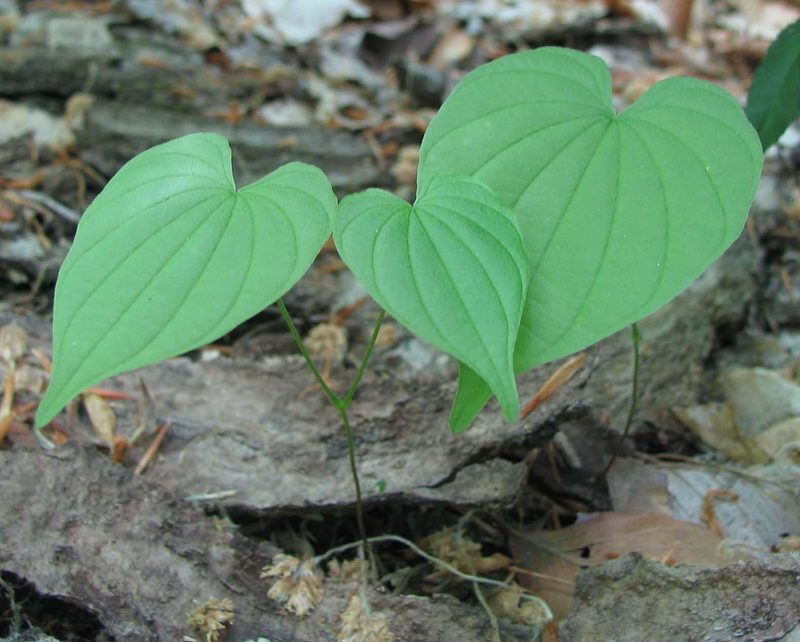
Photo: No machine-readable author provided. Phyzome assumed (based on copyright claims). · CC BY-SA 3.0 · Source
Wild Yam
Dioscorea paniculata
Family: Dioscoreaceae | Parts Used: Root
Wild Yam is a grounding, soothing root known for its ability to ease spasms, support digestive and reproductive health, and address liver and gallbladder function. Its warm, sweet-bitter nature and steroidal saponin content support bile flow and detoxification. Traditionally used in Native American and TCM practices for abdominal cramping, menstrual cramps, arthritic pain, and liver problems. Note: despite widespread marketing, wild yam cream is not converted to progesterone in the human body.
Traditional Uses
- Abdominal and intestinal cramping relief
- Menstrual cramp relief
- Liver problems and gallstone support; promotes bile flow
- Arthritic and rheumatic pain relief
- Relief from spasms and tension throughout the body
- Supports digestive detoxification
Key Constituents
Preparations & Dosage
- Tea (Decoction): 1-2 tsp dried root simmered in 1 cup boiling water for 10-15 minutes; taken 3 times daily.
- Tincture: 15-30 drops taken 3 times daily.
Cautions
- May interact with estrogen therapies and hormone-sensitive conditions.
- Wild yam cream is not converted to progesterone in the body, despite widespread marketing claims.
- Not recommended during pregnancy.
- Large doses may cause nausea and vomiting.
Habitat & Growing Conditions
Native to North America. Grows in USDA zones 5-9. Prefers moist, swampy soil in full sun to partial shade.
Related Articles
Sources & Research
The Way of Herbs, Michael Tierra, p207
The New Holistic Herbal, David Hoffmann, p241
Published Research:
Diarylheptanoids from Dioscorea villosa (Wild Yam) | Journal of Natural Products (2012)
Effects of wild yam extract on menopausal symptoms, lipids and sex hormones in healthy menopausal women | Climacteric (2001)
Value addition and influence of succinylation levels on the quality of wild yam (Dioscorea villosa) starch | Food and Function (2020)
Uncommon trajectories: steroid hormones, Mexican peasants, and the search for a wild yam | Studies in History and Philosophy of Biological and Biomedical Sciences (2005)
These statements have not been evaluated by the Food and Drug Administration. This information is not intended to diagnose, treat, cure, or prevent any disease. If you are under the care of a health care provider or taking prescription medication, check with your provider before using any herbal supplement.