

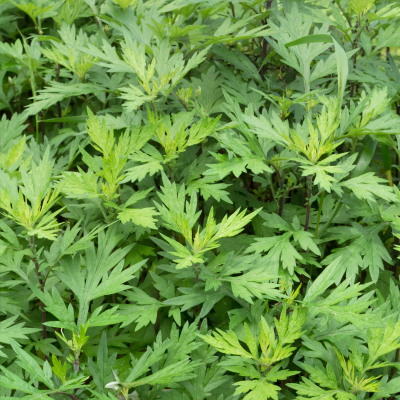
Mugwort
Artemisia vulgaris
Family: Compositae | Parts Used: Leaves and root
Mugwort is a stimulating herb with a long history in both medicine and folk practice. Its earthy, aromatic bitterness drives its use as a digestive bitter tonic, emmenagogue, and liver cleanser. In TCM, moxa made from dried mugwort leaf is burned at acupuncture points. In Western and Japanese folk practice, it is traditionally used for dream work and spiritual protection.
Traditional Uses
- Supports digestion as a bitter tonic
- Encourages menstruation (emmenagogue)
- Expels intestinal parasites
- Cleanses the liver
- Soothes external inflammation (topical)
- Burned at acupuncture points in TCM (moxibustion)
Properties
Key Constituents
Preparations & Dosage
- Infusion: 1-2 teaspoons herb per 1 cup boiling water; or 1 oz dried herb per 1 pint water. Take 1 cup once or twice daily.
- Tincture: 15-30 drops once or twice daily.
- Moxa (TCM): Dried leaf compressed into sticks or cones and burned near acupuncture points.
- Candle blending: Dried herb added to candles for aromatic and folk uses.
Spiritual & Folk Uses
In folk practice, mugwort is traditionally used for psychic enhancement and protection. Placing dried mugwort in a red bag under the pillow is traditionally associated with vivid or lucid dreams. Burning the dried herb on a charcoal disc is used for cleansing and protection in folk rituals. I also use it in candle blends for its aromatic properties and its association with heightened awareness.
Bonnie's Notes
I use mugwort in candle blends. It adds an earthy, aromatic note and carries a long folk history that clients recognize and respond to.
Cautions
- Avoid during pregnancy. Mugwort stimulates uterine contractions.
- Not for long-term use.
- Do not consume in large amounts.
- Individuals with Asteraceae family allergies may react.
Habitat & Growing Conditions
Native to Europe and Asia. Naturalized across North America, growing in zones 3-8. Tolerates dry or moist soil and prefers full sun. Considered a common roadside weed in many regions.
Related Articles
Sources & Research
The New Holistic Herbal, David Hoffmann, p216
Herbs: An Illustrated Encyclopedia, Kathi Keville, p49
Published Research:
Towards a better understanding of Artemisia vulgaris: Botany, phytochemistry, pharmacological and biotechnological potential | Food Research International (2018)
Effectiveness of Stimulation of Acupoint KI 1 by Artemisia vulgaris (Moxa) for the treatment of Essential Hypertension | Evidence-Based Complementary and Alternative Medicine (2014)
Immunomodulatory potential of Artemisia vulgaris: An insight into underlying immunological mechanisms | Journal of Environmental Pathology, Toxicology and Oncology (2019)
Significance of Artemisia Vulgaris L. (Common Mugwort) in the History of Medicine and Its Possible Contemporary Applications | Molecules (2020)
These statements have not been evaluated by the Food and Drug Administration. This information is not intended to diagnose, treat, cure, or prevent any disease. If you are under the care of a health care provider or taking prescription medication, check with your provider before using any herbal supplement.