

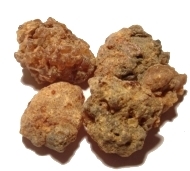
Photo: derivative work: Photohound (talk) IncenseWikiVers.jpg: Transferred from en.wikipedia to Commons by Trengarasu using CommonsHelper. The original uploader was Sjschen at English Wikipedia. · CC BY-SA 3.0 · Source
Myrrh
Commiphora myrrha
Family: Burseraceae | Parts Used: Resin, essential oil
Myrrh is a resin tapped from the Commiphora tree, with thousands of years of recorded use across Middle Eastern, African, and Ayurvedic traditions. Its rich, earthy, balsamic scent has made it a standard in ritual incense blending for cleansing and grounding. Research into its furanosesquiterpenoid compounds investigates anti-inflammatory, antimicrobial, and bone-protective activity. It also appears in traditional contexts for respiratory and digestive support.
Traditional Uses
- Ritual purification and cleansing (incense)
- Blessing and promoting peace and healing (incense)
- Grounding and introspection in ritual practice
- Traditionally used for respiratory support in Ayurvedic and Middle Eastern medicine
- Traditional digestive and immune support
- Topical wound care and oral health in Middle Eastern and African traditions
Properties
Key Constituents
Preparations & Dosage
- Incense: Burned alone or blended with other resins and herbs on a charcoal disc. Used for cleansing a space or for ritual purposes.
- Essential oil: Used in aromatherapy and topical blends. Dilute with a carrier oil before skin application.
Spiritual & Folk Uses
Myrrh has been used in ritual incense across Middle Eastern, African, and Mediterranean traditions for millennia. It is traditionally burned, blended with other resins or herbs, to cleanse a space of stagnant or unwanted energy, and separately to bless and promote peace and healing. It appears in ancient Egyptian embalming, Hebrew religious ceremony, and Ayurvedic ritual. The resin's dense, persistent smoke and grounding scent are consistent across these traditions. See also: New Year's Spiritual Cleansing, Honoring Your Ancestors.
Bonnie's Notes
I use myrrh frequently in incense blends. It anchors a blend with depth and tends to blend well with frankincense, dragon's blood, and lighter floral resins. Clients respond strongly to the scent, which carries its own recognition from cultural memory.
Cautions
- Avoid during pregnancy and breastfeeding.
- Consult a healthcare provider before internal use, particularly if taking any medications.
Habitat & Growing Conditions
Native to Africa and the Middle East, particularly Somalia, Ethiopia, Yemen, and Oman. Grows in hot, arid, desert conditions with full sun and rocky or sandy soil. The resin is harvested by cutting the bark and allowing sap to dry and harden into irregular lumps.
Related Articles
Sources & Research
Published Research:
In vitro cytogenotoxic and mutagenic effects of Commiphora myrrha essential oil | Drug and Chemical Toxicology (2022)
Commiphora myrrha acute toxicity | Clinical Toxicology (2024)
Anti-Osteoporotic Effects of Commiphora Myrrha and Its Poly-Saccharide via Osteoclastogenesis Inhibition | Plants (2021)
Furanosesquiterpenoids of Commiphora myrrha | Journal of Natural Products (2001)
These statements have not been evaluated by the Food and Drug Administration. This information is not intended to diagnose, treat, cure, or prevent any disease. If you are under the care of a health care provider or taking prescription medication, check with your provider before using any herbal supplement.