

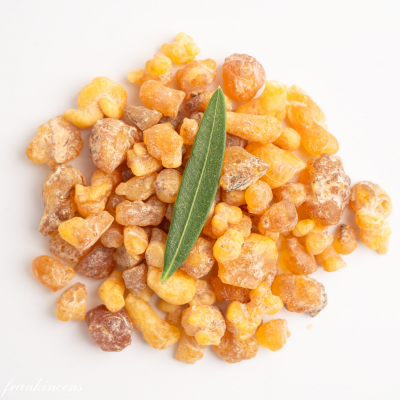
Frankincense
Boswellia papyrifera
Family: Burseraceae | Parts Used: Resin, essential oil
Frankincense is a resin from the Burseraceae family, traditionally burned for purification and used in spiritual ceremonies across African, Middle Eastern, Ayurvedic, and TCM traditions for centuries. It is valued primarily for its applications in spiritual practice, including cleansing spaces, enhancing meditative focus, and ancestral work. The essential oil is also used in skin care formulations.
Traditional Uses
- Cleansing and consecrating spaces (burned as incense)
- Enhances focus during meditation and spiritual practice
- Blessing mojo bags and empowering other spiritual workings via essential oil, resin pieces, or powder
- Ancestral work and ritual smoke
- Skin care: essential oil added to lotions and soaps
Properties
- Aromatic
- Purifying (traditional)
- Anti-inflammatory (Boswellia species broadly)
- Skin-conditioning (essential oil)
Key Constituents
- Boswellic acids (resin)
- Essential oil
- Resin acids
- Pentacyclic triterpenes
Preparations & Dosage
- Incense: Burned as loose resin or resin pieces to cleanse and consecrate spaces.
- Essential oil: Used to bless mojo bags, empower spiritual workings, or incorporated into lotions and soaps for skin care.
- Resin powder: Added to incense blends and spiritual preparations.
Spiritual & Folk Uses
Frankincense has been burned in spiritual ceremonies across many cultures for centuries. In African, Middle Eastern, and Mediterranean traditions it is used to clear and consecrate spaces before ritual or prayer. In Ayurvedic and TCM practice, it has been applied to support grounding during meditation. The resin smoke is also used in ancestral work as an offering and as a medium for communication across spiritual traditions.
Bonnie's Notes
I use frankincense frequently in several incense blends. It's one of the most consistent resins for clearing a space before spiritual work.
Cautions
- Consult a healthcare provider before use, especially if pregnant or nursing.
- Not recommended during pregnancy or breastfeeding.
- Essential oil should be diluted before topical application; avoid contact with eyes.
Habitat & Growing Conditions
Native to Africa, India, and the Middle East. Grows in USDA zones 10-11. Prefers full sun, heat, and drought conditions. The resin is harvested by tapping the bark of the tree.
Related Articles
Sources & Research
Published Research:
Neuroprotective effects of a combination of Boswellia papyrifera and Syzygium aromaticum on AlCl3 induced Alzheimer's model | Brazilian Journal of Biology (2023)
Formulation and In Vitro Evaluation of Furosemide Floating Matrix Tablets Using Boswellia papyrifera Resin as Matrix Former | BioMed Research International (2023)
Discovery of papyifuran A as an unusual cembrane diterpenoid from Boswellia papyrifera resin | Acta Pharmaceutica Sinica B (2025)
Bioactive constituents from Boswellia papyrifera | Journal of Natural Products (2005)
These statements have not been evaluated by the Food and Drug Administration. This information is not intended to diagnose, treat, cure, or prevent any disease. If you are under the care of a health care provider or taking prescription medication, check with your provider before using any herbal supplement.